Why New Language Features Need to Target AI Agents, Not Developers
AI agents are writing our production code. It's time to stop designing syntax sugar for humans and start optimizing languages for bots.
Originally published on DEV Community by ModernCpp. Read on the original site
title: Why New Language Features Need to Target AI Agents, Not Developers published: true description: AI agents are writing our production code. It's time to stop designing syntax sugar for humans and start optimizing languages for bots. tags: ai, softwarearchitecture, programming, computerscience
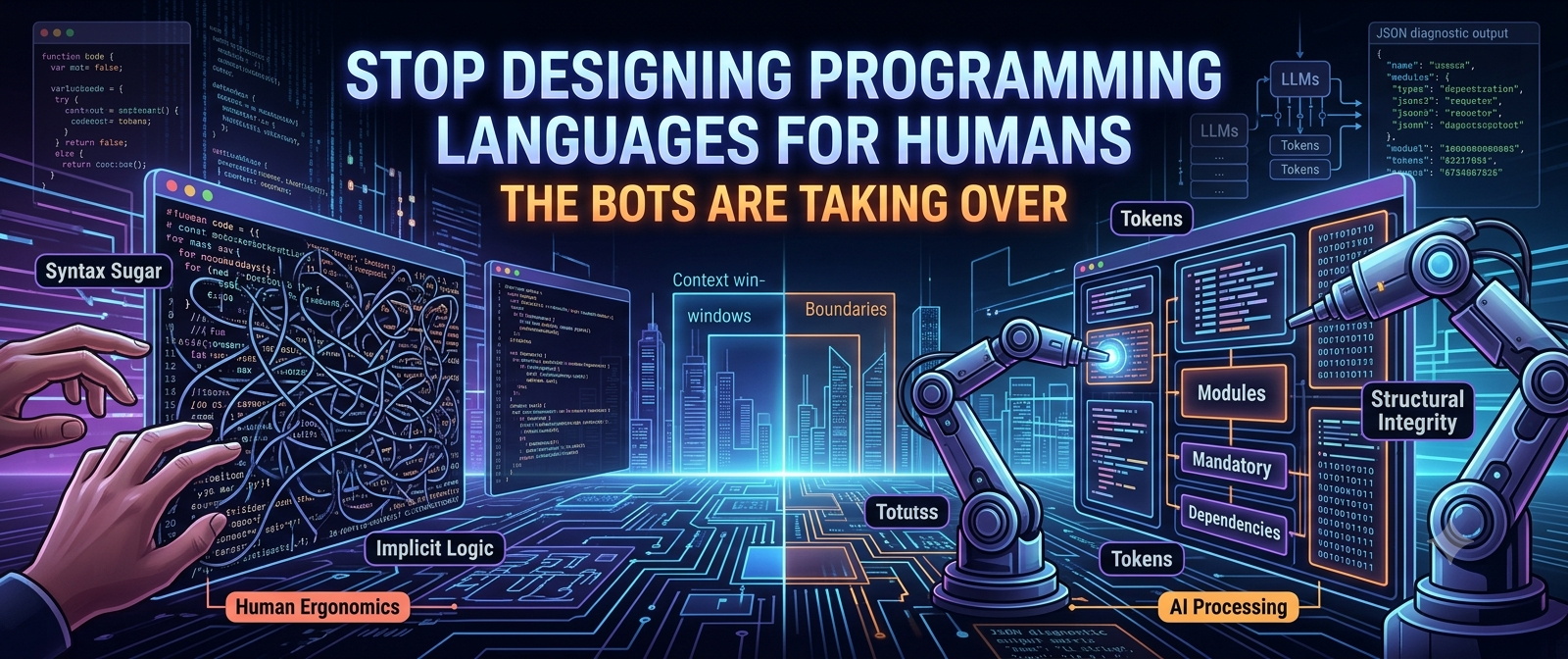
cover_image: https://www.cppdepend.com/img/BotLanguage.jpg
Use a ratio of 100:42 for best results.
published_at: 2026-06-11 13:59 +0000
For the last 50 years, programming language evolution has had one single north star: Human Ergonomics. We design syntax sugar, optional typing, and complex implicit behaviors to make code faster to write and easier for human brains to read.
But we are ignoring the elephant in the repository.
With autonomous platforms like OpenHands, GitHub Copilot workspace, and custom multi-agent reasoning loops writing, refactoring, and deploying code, the primary consumer of source code is radically changing. We aren’t just writing code for our peers anymore; we are writing code that AI agents must ingest, parse, and modify.
It’s time to face a contrarian truth: New language features must be optimized for AI processing, not human typing convenience.
1. Syntax Sugar is Token Poison
Humans love concise, clever shortcuts. We love implicit returns, ternary operators, and magical macros that turn 10 lines of code into 1.
For an AI, however, syntax sugar often adds unnecessary ambiguity. When an LLM generates or parses code, it breaks it down into tokens. Highly implicit, dense syntax requires more reasoning steps and token overhead for the model to successfully predict structural intent.
Instead of adding more magical, compressed syntax features, modern language updates should focus on explicitness. Explicit type declarations, mandatory block boundaries, and structured configurations make it vastly easier for an AI agent to read an abstract syntax tree (AST) and execute a flawless refactor without hallucinating edge cases.
2. The Nightmare of Code Sprawl and Context Windows
AI agents can write code faster than any human engineering team in history. But that speed introduces a terrifying side effect: Accelerated Code Sprawl. When bots generate thousands of lines of code across massive dependency structures, they easily shoot past their own context window limitations. If a language allows tightly coupled architectures, messy implicit imports, or sprawling global states, the AI will quickly lose track of the codebase logic, resulting in catastrophic dependency loops and structural decay.
Languages need built-in architectural guardrails. We don't need features that let us write code faster; we need language features that enforce strict boundaries, isolate modules natively, and flag structural corruption right at the compiler level.
3. Designing for Compiler-Driven AI Feedback
The most effective way an AI agent improves its code is through a tight feedback loop with the compiler or a static analyzer.
If an LLM writes bad code, a cryptic compiler error message helps no one. Language features should evolve to provide semantic, structured error payloads (like JSON-formatted diagnostics) rather than raw text outputs. Imagine a compiler or static analysis engine that doesn't just say Error: NullPointerException, but explicitly outputs a deterministic matrix map of the structural loop causing the failure.
When the language infrastructure speaks the same structured data language as the AI, agentic self-healing code transitions from a sci-fi concept into standard CI/CD reality.
Conclusion: The New Dev/AI Symbiosis
This doesn't mean human developers are obsolete. It means our roles are shifting from "code typists" to software architects and system reviewers.
If we continue to update languages like C++, Java, or Rust based purely on how many keystrokes it saves a human finger, we are optimizing for the past. The languages that dominate the next decade will be the ones that turn code into a clear, predictable, and highly structured data asset that AI agents can refactor with 100% mathematical precision.
What do you think? Should language designers start prioritizing LLM readability over human convenience, or are we risking making code completely unreadable for the humans left in the loop? Let’s discuss in the comments below.
Originally published on DEV Community by ModernCpp. Read on the original site